
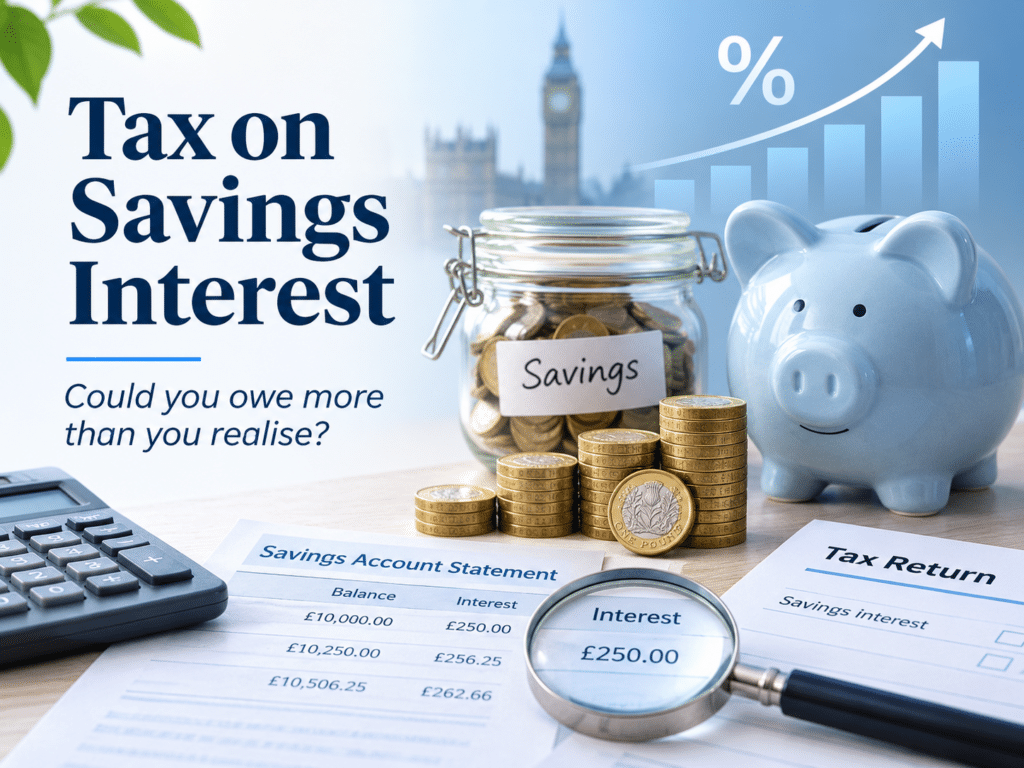
For many years, interest rates on savings accounts were so low that paying tax on savings interest wasn’t something most people needed to worry about.
But with savings rates having been higher in recent years, that’s changed.
You might have money spread across several bank accounts, a fixed-rate savings bond and an easy-access account. Each one is earning interest, which is great news.
However, what many people don’t realise is that the interest earned across all your taxable savings accounts is added together when calculating whether you owe Income Tax.
And depending on how much you earn and how much interest you receive, you could find yourself with an unexpected tax liability.
So, how does it work, how much interest can you earn tax-free, and what can you do to make your savings more tax-efficient?
Let’s take a look.
Do you have to pay tax on savings interest?
Potentially, yes.
Although the money you originally put into a savings account may already have come from income you’ve paid tax on, the interest it earns is treated separately for tax purposes.
Savings income can include:
- Interest from ordinary bank and building society savings accounts.
- Interest from fixed-rate savings accounts and savings bonds.
- Interest earned on current accounts that pay interest.
- Interest from certain credit union accounts.
- Interest from some National Savings and Investments (NS&I) products.
- Interest from certain other investments and financial arrangements.
Not every savings product is taxed in the same way. For example, interest from Cash ISAs is normally free from UK Income Tax.
But if you’re holding money in ordinary savings accounts, it’s worth understanding how much interest you’re earning each year.
What is the Personal Savings Allowance?
The Personal Savings Allowance (PSA) allows many people to earn a certain amount of savings interest each tax year without paying Income Tax on it.
How much you can receive depends on which Income Tax band you fall into.
For the 2026/27 tax year, the allowances are:
Income Tax band | Personal Savings Allowance |
Basic-rate taxpayer | £1,000 |
Higher-rate taxpayer | £500 |
Additional-rate taxpayer | £0 |
For example, if you’re a basic-rate taxpayer, you can usually receive up to £1,000 in taxable savings interest during the tax year without paying Income Tax on that interest.
If you’re a higher-rate taxpayer, the allowance falls to £500.
And if you’re an additional-rate taxpayer, you don’t receive a Personal Savings Allowance at all.
These allowances apply to the individual, not to each savings account.
It’s also important to remember that savings interest itself can affect your tax band, so your allowance isn’t always determined solely by your salary or pension income.
What happens if you have several savings accounts?
This is where people can easily get caught out.
Imagine you have money in three different savings accounts:
Savings account | Annual interest |
Easy-access savings | £450 |
Fixed-rate savings bond | £600 |
Interest-paying current account | £150 |
Total interest | £1,200 |
If you’re a basic-rate taxpayer with the full £1,000 Personal Savings Allowance available, £200 of that interest would be taxable.
At the current 20% basic rate, that would mean £40 in tax.
It doesn’t matter that the interest came from three different accounts.
You don’t get a separate £1,000 allowance for every bank or building society you save with.
All your taxable savings interest is considered together.
Why higher savings rates can lead to an unexpected tax bill
Higher interest rates can be welcome news for savers.
But they can also mean you reach your tax-free allowance much sooner than you might expect.
For example, imagine you have £30,000 in a savings account paying 4% annual interest.
Over a full year, that could generate approximately £1,200 in interest.
For a basic-rate taxpayer with a £1,000 Personal Savings Allowance, £200 would be taxable, resulting in a £40 tax bill at the current basic rate.
Now imagine you’re a higher-rate taxpayer.
With a Personal Savings Allowance of just £500, £700 of the interest would be taxable.
At the current 40% higher rate, that could mean £280 in tax.
And that’s from just one savings account.
If you have additional savings elsewhere, your total taxable interest could be considerably higher.
These examples assume the full interest amount is taxed at the stated rate and no other savings allowances are available.
Could your savings interest push you into a higher tax band?
Yes, and this is something that’s often overlooked.
Savings interest is included when calculating your taxable income.
That means it can affect which Income Tax band you fall into.
For example, you might be earning just below the higher-rate Income Tax threshold through your salary or pension income.
If you then receive a significant amount of savings interest, some of that interest could fall into the higher-rate band.
This may also affect your Personal Savings Allowance, potentially reducing it from £1,000 to £500.
It’s therefore important to consider your overall taxable income rather than looking at your savings interest in isolation.
For people close to an Income Tax threshold, even a relatively modest amount of additional interest can make a difference.
What is the starting rate for savings?
There is another tax allowance that doesn’t receive as much attention.
It’s called the starting rate for savings, and it can be particularly helpful for people with relatively low income from other sources.
Under the current rules, eligible individuals may be able to receive up to £5,000 of savings interest taxed at 0%.
However, the amount available depends on how much other income you receive.
For 2026/27, if your non-savings income is £12,570 or less, you may qualify for the full £5,000 starting rate band.
For every £1 of non-savings income above £12,570, the available starting rate band is reduced by £1.
Once your non-savings income reaches £17,570, the starting rate is no longer available.
This means the starting rate is most relevant to people with lower levels of earnings or pension income.
It can be particularly useful for some retirees, part-time workers or people who have stopped working but haven’t yet started receiving significant pension income.
Depending on their circumstances, some individuals may be able to benefit from their Personal Allowance, the starting rate for savings and the Personal Savings Allowance.
Which savings accounts are tax-free?
Not all savings interest is subject to Income Tax.
One of the best-known tax-efficient savings options is a Cash ISA.
Interest earned within a Cash ISA is normally free from UK Income Tax, regardless of how much interest the account generates.
It also doesn’t count towards your Personal Savings Allowance.
For the 2026/27 tax year, the overall ISA subscription allowance is £20,000 per adult.
This can make ISAs particularly attractive for people who have already used up their Personal Savings Allowance.
Other tax-free savings products include certain NS&I products, such as Premium Bonds, where prizes are tax-free.
However, Premium Bonds don’t pay guaranteed interest, and returns depend on prize draws.
It’s worth comparing the terms, access arrangements and expected returns of different savings products rather than assuming one option will always be best.
How does HMRC know how much interest you’ve earned?
You might be wondering how HMRC knows whether you’ve exceeded your Personal Savings Allowance, particularly if you haven’t reported your interest yourself.
Banks and building societies generally provide HMRC with information about interest paid to customers.
HMRC can use this information to estimate how much taxable savings interest you’ve received.
If you’re employed or receiving a pension through PAYE, HMRC may collect tax due on savings interest by adjusting your tax code.
This means you could end up paying slightly more tax through your salary or pension without receiving a separate bill.
In some cases, HMRC may initially use previous years’ interest figures to estimate what you’re likely to earn in the current year.
If you’re required to complete a Self Assessment tax return, you’ll normally need to include your taxable savings interest as part of that return.
The important point is that you don’t necessarily have to receive a separate tax bill to be paying tax on your savings interest.
It could already be reflected in your tax code.
What if HMRC has calculated your savings interest incorrectly?
Mistakes or differences can happen, particularly if you’ve moved money between accounts, closed an account or received an unusually large interest payment in a previous tax year.
If you think HMRC has used the wrong figures, don’t simply assume they’re correct.
You can:
- Check your annual interest statements from your banks and building societies.
- Review your tax code and the savings income HMRC has included.
- Compare HMRC’s figures with the interest you actually received during the relevant tax year.
- Contact HMRC if you believe the figures need correcting.
- Check that any interest already reported through Self Assessment has been accounted for correctly.
Remember that tax is generally based on when interest is received or made available, which can be particularly important for some fixed-term savings products.
Keeping accurate records can make it much easier to resolve any discrepancies.
Are you keeping too much money in taxable savings accounts?
Holding money in cash is an important part of financial planning.
It’s sensible to have an emergency fund, and money you expect to need in the short term will often be more appropriately held in accessible savings rather than investments.
But if you’re holding substantial amounts in ordinary savings accounts and regularly exceeding your Personal Savings Allowance, it may be worth reviewing how your money is structured.
For example, you might want to consider whether some savings could be held within a Cash ISA, subject to your available allowance.
You might also want to review how much cash you actually need to keep readily available and whether longer-term savings could be working towards other financial goals.
That doesn’t automatically mean you should move your money into investments.
Investments carry risk, and their value can fall as well as rise.
The right approach depends on your circumstances, your timescales and how much risk you’re comfortable taking.
The highest interest rate isn’t always the best return
When comparing savings accounts, it’s natural to look for the highest advertised interest rate.
But if you’re paying tax on some or all of the interest, the figure that really matters is what you keep after tax.
For example, consider a savings account paying 4% interest.
If all the interest is taxable at the current higher rate of 40%, the effective after-tax return would be just 2.4%.
Savings account | Gross interest rate | After-tax rate |
Taxable account – basic rate at 20% | 4.0% | 3.2% |
Taxable account – higher rate at 40% | 4.0% | 2.4% |
Taxable account – additional rate at 45% | 4.0% | 2.2% |
Cash ISA | 4.0% | 4.0% |
Illustrative examples assuming all interest in the taxable account is subject to the stated tax rate. Actual tax depends on individual allowances and circumstances.
This is why a Cash ISA offering a slightly lower headline interest rate could sometimes provide a better after-tax return than a taxable savings account.
Of course, interest rates, withdrawal restrictions and account terms still matter.
But comparing the after-tax return gives you a more meaningful picture of what your savings are actually earning.
What’s changing from April 2027?
There is another important reason to pay attention to tax on savings interest.
From 6 April 2027, the UK Government has confirmed that Income Tax rates on savings income will increase by two percentage points.
The new rates are due to be:
Savings Income Tax band | Current rate (2026/27) | From 2027/28 |
Basic rate | 20% | 22% |
Higher rate | 40% | 42% |
Additional rate | 45% | 47% |
This means that, for people who exceed their available savings allowances, more of their interest could be lost to tax.
For example, if a higher-rate taxpayer has £2,000 of taxable savings interest after their available allowances, the tax would currently be £800.
From April 2027, at the proposed 42% rate, the same amount of taxable interest would result in £840 of tax.
That’s an additional £40.
It might not sound significant in isolation, but for people with substantial cash savings, the impact could be greater over time.
The Personal Savings Allowance remains an important part of the calculation, and the increase in savings tax rates doesn’t mean that all savers will suddenly start paying tax.
However, it does make tax-efficient savings arrangements worth reviewing.
How do savings fit into your wider financial plan?
Your savings shouldn’t be considered separately from the rest of your finances.
Cash ISAs, pensions, investments and ordinary savings accounts all have different purposes, benefits and tax treatments.
For example:
- Cash savings can provide security and access to money for emergencies or planned expenditure.
- Cash ISAs can offer tax-free interest while retaining the characteristics of a savings account.
- Stocks and Shares ISAs can provide tax-efficient opportunities for longer-term investing, although investment values can fluctuate.
- Pensions can offer valuable tax advantages when saving for retirement, subject to the relevant rules and allowances.
The aim isn’t necessarily to minimise tax at every opportunity.
It’s to make sure your money is held in the most appropriate places for your needs, while avoiding unnecessary tax where possible.
Someone approaching retirement may need a very different balance between cash and investments compared with someone who is still twenty years away from retiring.
And that’s where looking at the bigger picture can make a real difference.
How Lazenby’s Financial Services can help
At Lazenby’s Financial Services, we believe it’s important to understand not just how much your money is earning, but how it fits into your overall financial plans.
If you have substantial cash savings, we can help you consider whether your current arrangements remain appropriate, how your savings interact with your other income and whether there are more tax-efficient ways to structure your finances.
Through financial planning and cashflow modelling, we can look at your savings, pensions and investments together, helping you understand how your money could support both your short-term needs and long-term goals.
With changes to savings income tax rates approaching in April 2027, now could be a useful time to review your arrangements.
After all, it’s not just about how much interest your savings earn. It’s about how much of that interest you actually get to keep.
If you’d like to review your savings and wider financial plans, contact the team at Lazenby’s Financial Services.
Visit www.lazenbysfs.co.uk to find out more.
Important information: This article is for general information only and does not constitute personal financial or tax advice. Tax treatment depends on individual circumstances and may change. Savings rates are illustrative and are not guaranteed. Investments can fall as well as rise in value, and you may get back less than you invest.
Important additional point for the April 2027 changes
We have verified the 22%, 42% and 47% savings income tax rates against the Finance Act 2026: www.Legislation.gov.uk
“What’s changing from April 2027?”
There is another change worth knowing about. From April 2027, the annual Cash ISA subscription limit is due to reduce to £12,000 for savers under 65, while those aged 65 and over will continue to be able to subscribe up to £20,000 to Cash ISAs. The overall annual ISA allowance will remain £20,000, meaning younger savers can still use the remaining allowance for other eligible types of ISA. This makes it even more important to consider how your cash savings and investments are structured.
This additional change is included in HMRC’s published technical guidance: www.GOV.UK
It is particularly relevant to Lazenby’s clients who hold substantial cash savings and may benefit from reviewing their tax-efficient allowances before April 2027.