
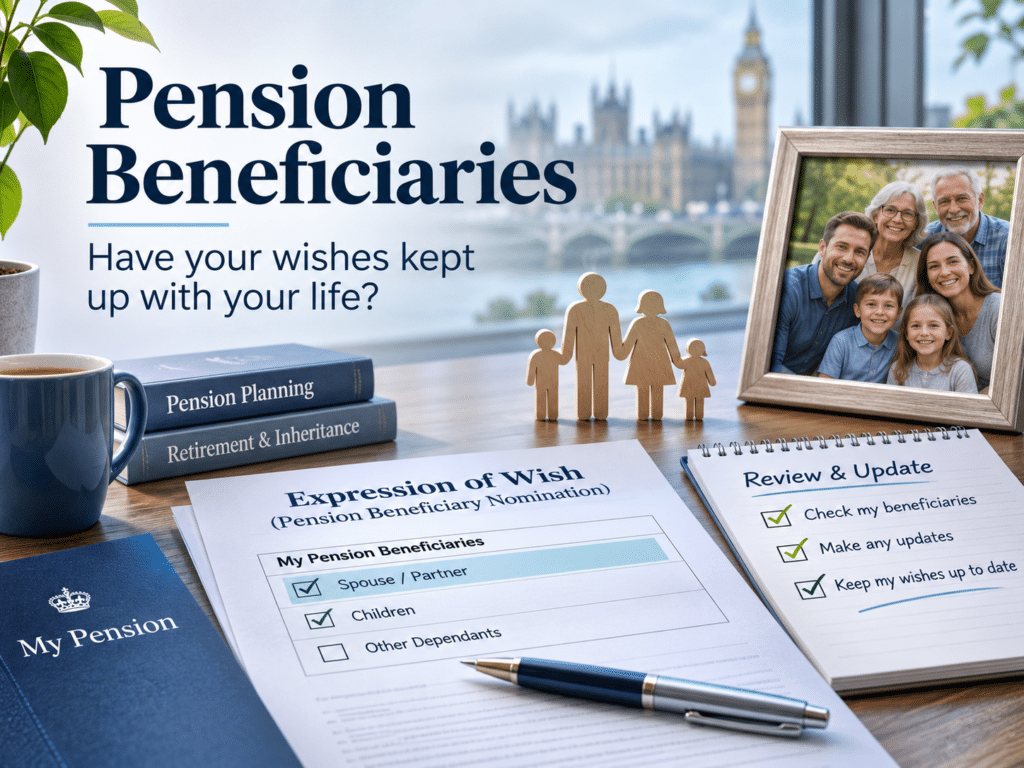
You’ve spent years building up your pension for retirement. But have you thought about who would receive it if you died?
It’s probably not something you think about very often. After all, when we’re planning for retirement, most of our attention is focused on how much we’re saving, when we can afford to stop working and whether our money will last.
But there’s another important question that often gets overlooked.
Who would you want to benefit from your pension if you were no longer here?
Perhaps you completed a form when you first joined your workplace pension 20 years ago. Maybe you nominated your husband, wife or partner at the time. Or perhaps you can’t remember filling one in at all.
Life changes, families grow and relationships evolve. But your pension paperwork doesn’t automatically keep up.
That’s why it’s worth checking something called your expression of wish.
What is an expression of wish?
An expression of wish is a form that tells your pension provider or scheme trustees who you would like to receive any pension death benefits when you die.
Depending on your pension scheme, these benefits could include money remaining in your pension pot or certain payments to your loved ones.
You can usually nominate your spouse, civil partner, children, grandchildren or other people who are important to you. Some schemes may also allow nominations of charities or trusts.
For example, you might want your pension benefits to go:
- 100% to your spouse or partner.
- 50% to your spouse and 25% to each of your two children.
- Equally between your three children.
- To a particular family member or another person who depends on you financially.
Where the scheme allows, you can indicate the percentage you would like each beneficiary to receive.
The important thing is that your wishes are recorded and kept up to date.
Is an expression of wish legally binding?
Usually, no. And this is an important distinction.
In many pension schemes, an expression of wish is a guide rather than a legally binding instruction.
The pension scheme trustees or provider will normally consider your wishes when deciding who should receive the benefits, but they may have discretion over the final decision.
They might also consider your family circumstances, financial dependants, relationships and the scheme’s rules.
For example, imagine you nominated your former partner many years ago, but you’ve since separated, remarried and had children.
If your nomination hasn’t been updated, the trustees may need to investigate your circumstances and decide how the benefits should be distributed.
Your old nomination could still be considered, even if it no longer reflects what you would have wanted.
Some pension schemes operate differently and allow binding nominations or directions. Where these are valid under the scheme rules, they can determine who receives the benefits rather than simply expressing a preference.
That’s why it’s important to understand exactly how your own pension scheme operates.
An expression of wish, a binding nomination and a legally binding direction aren’t necessarily the same thing.
Why your pension nomination could be out of date
Think about how much your life has changed over the past ten or twenty years.
You might have married, divorced, started a new relationship, had children or welcomed grandchildren.
Perhaps someone you originally nominated has died, or your family circumstances have changed significantly.
Any of these events could affect who you would now want to receive your pension benefits.
Some of the most important times to review your expression of wish include:
- Getting married or entering a civil partnership.
- Separating or getting divorced.
- Starting a new long-term relationship.
- Having children or grandchildren.
- The death of someone you’ve previously nominated.
- A change in financial dependants.
- Significant changes to your family or financial circumstances.
And here’s something that might surprise you.
Getting divorced doesn’t necessarily mean your former spouse has automatically been removed from your pension nomination.
The way a divorce affects pension death benefits depends on the type of pension, its rules and any relevant legal arrangements.
An old nomination may still be on file, even if your personal circumstances have changed completely.
It’s much better to check and update your wishes than assume everything has been taken care of.
What happens if you haven’t nominated anyone?
If you die without completing an expression of wish, your pension benefits don’t necessarily disappear.
However, what happens next will depend on the type of pension you have and the scheme’s rules.
For pensions where trustees or providers have discretion, they may need to investigate your personal circumstances to establish who should receive the benefits.
This could involve contacting family members, identifying financial dependants and reviewing any relevant information about your relationships.
In other schemes, the rules may specify who is eligible to receive certain benefits.
The process can become more complicated if there are several potential beneficiaries or disagreements within the family.
Completing an expression of wish won’t eliminate every possible difficulty, but it can provide valuable guidance and help the trustees or provider understand your intentions.
Isn’t this already covered in my will?
Not necessarily.
This is one of the most common misunderstandings about pension death benefits.
Your will sets out how you would like your estate to be distributed when you die.
However, many pension death benefits are paid under separate pension scheme arrangements and may not be controlled by the instructions in your will.
For example, you might have updated your will to leave your assets to your children, but your pension provider could still have an expression of wish naming your former spouse.
The pension trustees or provider may take that nomination into account when deciding who receives the pension benefits.
Equally, changing your expression of wish doesn’t automatically update your will.
Your will and your pension beneficiary nominations should be reviewed together, but they are separate documents with different purposes.
Do all pensions work in the same way?
No, and this is another reason why checking your individual pension arrangements matters.
Broadly speaking, there are two main types of workplace pension.
Defined contribution pensions
These are pensions where you and, often, your employer pay money into a pension pot that is invested over time.
The eventual value depends on factors such as contributions, investment performance and charges.
Depending on the scheme rules and the options available, any remaining pension funds may be payable to your nominated beneficiaries when you die.
An expression of wish can help the provider or trustees understand who you would like to benefit.
Defined benefit or final salary pensions
These pensions work differently.
Rather than having an individual investment pot that can simply be passed on, they generally promise a retirement income based on the scheme’s benefit formula.
When you die, the scheme may provide benefits such as a dependant’s pension, a lump sum or certain guaranteed payments.
However, not everyone you nominate will necessarily be eligible to receive those benefits.
For example, a final salary scheme may only pay an ongoing dependant’s pension to a surviving spouse, civil partner, qualifying partner or eligible child, depending on its rules.
An expression of wish cannot override those eligibility requirements.
This means it’s particularly important to understand what your pension actually provides on death, rather than assuming all pensions can be passed on in the same way.
Should you nominate one person or several?
There’s no single answer that works for everyone.
You may want your spouse or partner to receive everything. Alternatively, you may wish to divide the benefits between your partner, children or other family members.
Where the pension scheme allows you to nominate several beneficiaries, you can usually indicate how you would like the benefits divided.
For example, you might nominate your partner to receive 60% and your two children to receive 20% each.
But remember, with a discretionary expression of wish, these percentages are generally an indication of your wishes rather than a guarantee of how the benefits will be distributed.
It’s also worth considering what you would want to happen if one of your nominated beneficiaries died before you.
Some schemes allow you to record alternative beneficiaries or provide additional instructions.
If you’re unsure, ask your pension provider what options are available.
What if you have several pensions?
This is where things can easily become overlooked.
If you’ve worked for several employers, you may have accumulated a number of workplace pensions, as well as personal pensions you’ve arranged yourself.
Each pension could have a different provider, different scheme rules and a different beneficiary nomination.
You might have updated the nomination on your current pension but completely forgotten about a pension from a job you left fifteen years ago.
It’s worth making a list of all your pensions and checking the beneficiary details held by each provider.
You should also check that your contact information, name, address and other personal details are correct.
Keeping your records up to date can make it easier for providers to communicate with you and, ultimately, for the people you care about to receive the benefits intended for them.
How often should you review your expression of wish?
Don’t wait until something significant happens in your life.
Although major events such as marriage, divorce or the birth of a child should prompt an immediate review, it’s sensible to check your nominations regularly.
A good opportunity is during your annual financial planning review.
It doesn’t have to be complicated.
You simply need to ask yourself:
Are these still the people I would want to benefit from my pension if I died today?
If the answer is no, or you’re not sure, it’s time to check your pension records.
Even if nothing has changed, reviewing your nominations regularly gives you the reassurance that your wishes are still accurately recorded.
What about the inheritance tax changes coming in April 2027?
There is another important reason why pension death benefits should be part of your wider financial planning.
From 6 April 2027, most unused pension funds and pension death benefits are due to be included in the value of a person’s estate for inheritance tax purposes.
This is a significant change to the way many pensions are treated when someone dies.
Historically, many pension death benefits have generally sat outside the estate for inheritance tax purposes where pension trustees or providers have discretion over who receives them.
Under the new rules, most unused pension funds and relevant pension death benefits will be brought within the inheritance tax calculation, regardless of whether the scheme has discretion over payment.
This could mean that more families face an inheritance tax liability, depending on the value of the estate, the beneficiaries and the exemptions and allowances available.
There are important exceptions, and the treatment of different pension death benefits can vary. For example, registered pension scheme death-in-service benefits are intended to remain outside the scope of the new rules.
It’s also worth remembering that inheritance tax and income tax are separate considerations. The tax treatment of inherited pension benefits can depend on factors including the age of the person who died and the type of benefits paid.
Does this mean expression-of-wish forms are no longer important?
Absolutely not.
This is a key point.
Although the inheritance tax treatment of pension death benefits is changing, the rules about who receives those benefits remain important.
Where trustees or pension providers have discretion, they will still need to decide who should receive the benefits, taking account of the scheme rules and your recorded wishes.
The new inheritance tax rules don’t automatically turn an expression of wish into a legally binding instruction.
So, even after April 2027, keeping your beneficiary nominations accurate and up to date will remain an important part of financial planning.
In fact, the changes make it even more sensible to consider your pensions alongside the rest of your estate.
Pension beneficiaries are just one part of estate planning
When people think about estate planning, they often focus on writing a will or deciding who should inherit their home.
But good estate planning looks at the bigger picture.
This can include:
- Your will: Making sure your assets are distributed according to your wishes.
- Your pension nominations: Recording who you would like to receive your pension death benefits.
- Lasting Powers of Attorney (LPAs): Appointing trusted people to make decisions on your behalf if you lose the ability to make those decisions yourself.
- Life insurance: Reviewing who would receive any payout and whether the policy is written in trust, where appropriate.
- Savings, investments and property: Understanding how these assets could be passed on and whether inheritance tax might apply.
It’s important that these arrangements work together rather than being considered in isolation.
For example, your will might be up to date, but your pension nominations and life insurance arrangements could still reflect your circumstances from many years ago.
A joined-up approach can help make sure your wishes are clear and your family is better prepared.
How Lazenby’s Financial Services can help
At Lazenby’s Financial Services, we believe financial planning isn’t just about building wealth for retirement. It’s also about making sure the people who matter to you are considered and protected.
As part of our regular client reviews, we can help you look at your pension arrangements, consider whether your beneficiary nominations remain appropriate and understand how your pensions fit into your wider estate planning.
With the inheritance tax changes approaching in April 2027, it’s particularly important to understand how your pensions, investments and other assets could be treated when you die.
We can also work alongside your solicitor or other professional advisers where specialist legal or estate planning advice is needed.
A simple beneficiary check today could make a meaningful difference to the people you leave behind.
If you haven’t reviewed your pension beneficiaries for a while, now is a good time to do so.
Contact the team at Lazenby’s Financial Services to arrange a review of your pensions and wider financial plans.
Visit www.lazenbysfs.co.uk to find out more.
Important information: This article is intended for general information only and does not constitute personal financial, tax or legal advice. Pension death benefits, inheritance tax treatment and beneficiary entitlements depend on individual circumstances and scheme rules. Tax legislation and allowances may change.
Accuracy check for publication
I’ve also checked the pension and inheritance tax information against current official guidance from HMRC and MoneyHelper.
Two particularly useful points to retain in the article are:
- The April 2027 inheritance tax changes are confirmed in legislation. Finance Act 2026 received Royal Assent in March 2026. The changes apply to deaths on or after 6 April 2027, with exemptions including registered pension scheme death-in-service benefits and certain defined benefit dependant pensions.
- Expression-of-wish forms remain important. MoneyHelper confirms that providers generally consider nominations but may retain the final decision, and recommends reviewing nominations after significant life changes, particularly divorce