Have you ever wondered what happened to that pension you paid into 20 years ago? Or how much you’ve actually saved for retirement across all your different jobs?
If you’ve worked for several employers throughout your career, there’s a good chance you’ve built up more than one pension pot. And if you’ve moved house, changed your name or switched jobs over the years, keeping track of them all might not be as straightforward as you’d like.
That’s where the new Pensions Dashboards come in.
The Government-backed initiative aims to make it much easier for people to find and view their pensions in one place, giving them a clearer picture of what they might have available when they retire.
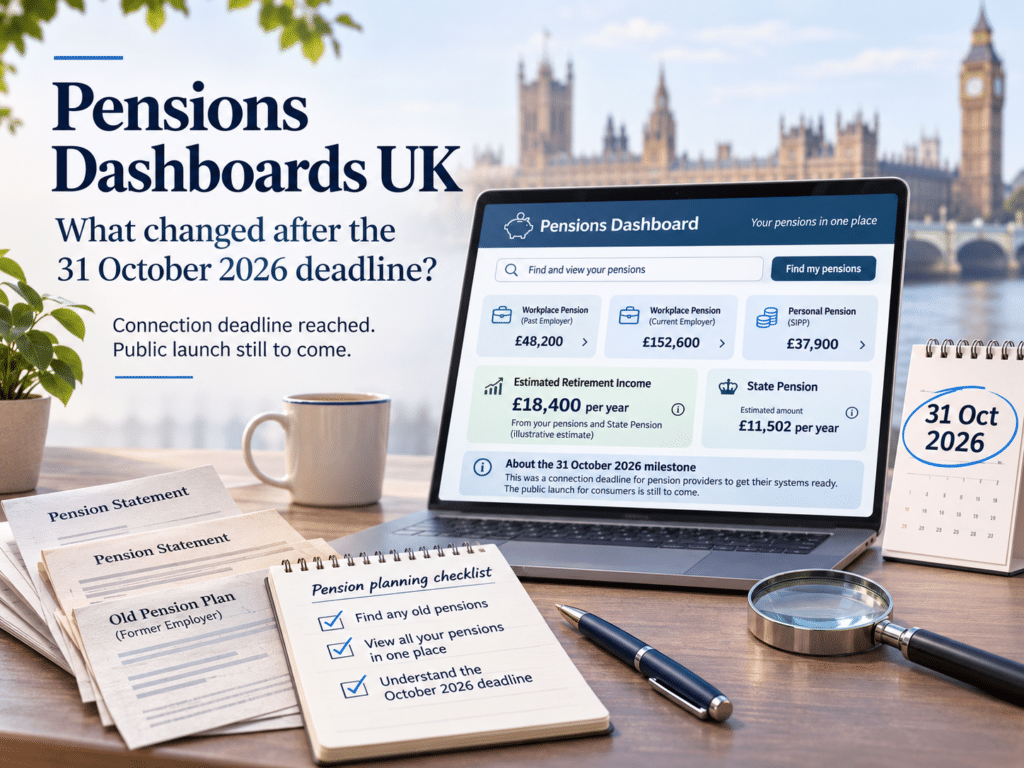
An important milestone arrived on 31 October 2026, the deadline for pension schemes and providers required to participate to connect to the pensions dashboards system.
But what does this actually mean for you? Can you now log in and see all your pensions? And will the dashboard tell you whether you’re saving enough for retirement?
Let’s take a closer look.
What changed on 31 October 2026?
The 31 October 2026 deadline was an important step towards making pensions easier to find.
Pension schemes and providers within the scope of the regulations were required to connect to the national pensions dashboards infrastructure by this date.
This includes most occupational pension schemes with 100 or more relevant members, alongside FCA-regulated providers of personal and stakeholder pensions within the scope of the rules.
The idea is that, once dashboards become available to the public, participating providers will be able to search their records securely when someone asks to find their pensions.
But here’s the important bit: 31 October was a connection deadline, not the public launch date.
It doesn’t mean that everyone can now log in and see all their pensions.
Think of it like building a new railway network. The tracks and stations need to be connected and tested before passengers can start using the service.
Pensions dashboards are working towards the same principle.
When will you be able to use a Pensions Dashboard?
The MoneyHelper Pensions Dashboard, being developed by the Money and Pensions Service, is intended to provide a free way for people to find and view information about their pensions.
However, connecting pension providers to the system is only part of the process.
Before dashboards can be made available to consumers, the system needs to undergo testing to make sure it works effectively, protects people’s personal information and provides a reliable service.
There is not yet a confirmed public launch date.
The MoneyHelper dashboard is expected to become available once the necessary testing and readiness requirements have been met, with the timing of consumer access to be confirmed officially.
So, although the October 2026 deadline represents a significant milestone, you shouldn’t expect to be able to access your pensions through a dashboard immediately.
What will you eventually be able to see?
Imagine being able to see your different pensions together without having to search through filing cabinets, old emails or paperwork from employers you left years ago.
That’s what pensions dashboards are designed to help you do.
Once available, they should allow you to:
- Find pension pots from previous employers.
- View details of personal pensions you’ve opened over the years.
- See information about your current workplace pension.
- Check the value of your pension savings or the benefits you’ve built up, where available.
- View retirement income estimates provided by your pension schemes.
- See information about your State Pension entitlement.
For someone who has worked for five or six different employers, this could be incredibly useful.
Rather than contacting each pension provider individually, you could have a much clearer starting point for understanding your retirement savings.
However, the information displayed will depend on the pension records held by each scheme and the data available. Not every pension will necessarily be found immediately.
Will old workplace pensions appear?
In many cases, yes. And this could be one of the biggest benefits of the new system.
Perhaps you worked for a company in your twenties and remember paying into a pension, but you’ve completely forgotten who managed it.
Or maybe you have an old personal pension that you haven’t reviewed for years.
If the pension is still held by a participating scheme or provider, and your details can be matched successfully, it should be possible for the dashboard to find it.
However, there are exceptions.
Some smaller occupational pension schemes are outside the mandatory connection requirements, and certain pension arrangements may not be included.
So, even when dashboards become available, they won’t necessarily provide a complete picture for everyone.
What if you’ve changed your name or moved house?
This is something worth thinking about now.
Pension providers will need to match the personal information supplied through a dashboard with the records they already hold.
If you opened a pension 25 years ago under a previous surname, or the provider still has an address you haven’t lived at for years, matching your pension could be more difficult.
It doesn’t mean your pension has disappeared. It may simply mean that the provider cannot confidently identify it as yours.
A few simple checks now could save you a lot of time later.
Consider:
- Checking that your current pension providers have your correct name, address and date of birth.
- Updating your details if you’ve married, divorced or changed your name.
- Making a list of previous employers and approximate employment dates.
- Keeping any old pension statements or policy numbers.
- Contacting previous employers or pension providers if you’re unsure where a pension is held.
You don’t need to wait for pensions dashboards to become available to start tracking down old pensions.
The Government’s free Pension Tracing Service can help you find contact details for workplace and personal pension schemes.
Will your State Pension be included?
Yes. The intention is for pensions dashboards to include information about your State Pension alongside your workplace and personal pensions.
This is important because your State Pension can form a significant part of your retirement income.
Seeing this information together could help you understand how your different sources of retirement income might fit together.
However, a State Pension forecast isn’t a guarantee of what you’ll receive, and it may depend on your National Insurance record and future contributions.
You can already check your State Pension forecast through the Government’s online service without waiting for dashboards to launch.
What happens if a pension is missing?
First of all, don’t panic!
A pension not appearing on a dashboard won’t automatically mean that your money has been lost.
There could be several reasons why a pension hasn’t been found, including outdated personal details, incomplete records, matching difficulties or a scheme that isn’t required to participate.
If you believe a pension is missing, you should contact the relevant provider or previous employer and check the information they hold.
You can also use the Pension Tracing Service to help identify who to contact.
It’s worth remembering that a pensions dashboard will be a useful tool, but it shouldn’t be treated as an infallible record of every pension you’ve ever held.
Does having several pensions mean you should combine them?
Not necessarily. And this is where people need to be careful.
One of the potential benefits of pensions dashboards is that you may discover pension pots you’d forgotten about.
You might find you have four or five different pensions, each with different providers, investment funds and charges.
It would be easy to assume that combining everything into one pension is the simplest solution.
But simpler doesn’t always mean better.
Some older pensions may have valuable benefits that you could lose by transferring them, including:
- Guaranteed annuity rates.
- Protected tax-free cash entitlements.
- Guaranteed investment returns or other valuable guarantees.
- Lower charges or favourable terms.
- Defined benefit pension promises.
Transferring a pension without understanding these benefits could leave you worse off.
In some circumstances, consolidation may make sense. It could simplify your paperwork, make your pensions easier to manage or help align your investments with your retirement objectives.
But the decision should be based on your individual circumstances, not simply on how many pension pots you have.
Finding a pension and deciding what to do with it are two very different things.
Will pensions dashboards replace financial advice?
No. And they aren’t intended to.
Pensions dashboards are designed to help you find and view information about your pensions.
They won’t automatically tell you whether you’re saving enough, whether your investments are suitable or whether you can afford to retire at your preferred age.
For example, imagine your dashboard eventually shows that you have £250,000 across several pension pots.
That’s useful information. But what does £250,000 actually mean for your retirement?
Could you afford to stop working at 60? Would your savings last if you lived into your nineties? How much income could you realistically withdraw each year? What happens if investment markets fall just as you’re approaching retirement?
These are the questions that require a much wider financial plan.
At Lazenby’s Financial Services, we use cashflow modelling to help clients explore how their pensions, savings, investments and other assets could support the retirement lifestyle they want.
We can look at different scenarios, including retiring earlier, reducing working hours, changing expenditure and understanding the potential impact of inflation or investment market downturns.
A pensions dashboard could provide valuable information to start that conversation, but it won’t replace the need for personalised financial planning.
Why now is a good time to review your pensions
Although the dashboards aren’t yet available to the public, the October 2026 connection deadline is a useful reminder to take stock of your retirement savings.
Many people spend years contributing to pensions without really knowing how much they’ve accumulated or whether they’re on track for the retirement they want.
And the closer you get to retirement, the more important those questions become.
You don’t need to wait for new technology to start getting organised.
Finding your existing pension statements, checking your State Pension forecast and reviewing your current retirement arrangements are all sensible steps you can take today.
When pensions dashboards eventually become available, they should make the process of locating and viewing pensions much easier.
But understanding what those pensions mean for your future is another matter.
How Lazenby’s Financial Services can help
At Lazenby’s Financial Services, we believe retirement planning is about much more than simply knowing how much money you have saved.
It’s about understanding what you want your retirement to look like and making sure your finances are working towards those goals.
Whether you’ve discovered an old pension, have several workplace pensions that you’ve never reviewed, or simply want to know whether you can afford to retire when you want to, we can help you build a clearer picture.
We can review your existing pension arrangements, assess the benefits and potential drawbacks of consolidation, and use financial modelling to help you understand how your savings could support your future plans.
Pensions dashboards could make finding your pensions easier. Good financial planning can help you understand what to do next.
If you’d like to review your pensions or discuss your retirement plans, get in touch with the team at Lazenby’s Financial Services.
Visit www.lazenbysfs.co.uk to find out how we can help.
Important information: This article is for general information only and does not constitute personal financial advice. Pension rules, taxation and benefits depend on individual circumstances and may change. The value of investments can fall as well as rise, and you may get back less than you invest.